
How does Pativo's symptom check decide how urgent it is?
You pick what you are seeing, describe it in your own words, and Pativo answers with one of five urgency levels, from Nothing alarming to Emergency (go now). An AI model reads the case, then fixed safety rules on the server check it again and can only raise the urgency, never lower it. It never diagnoses and never names a drug or a dose.
- 1Nothing alarmingWatch at home
- 2Worth watchingMonitor for a few days
- 3See a vet soonWithin 48 hours
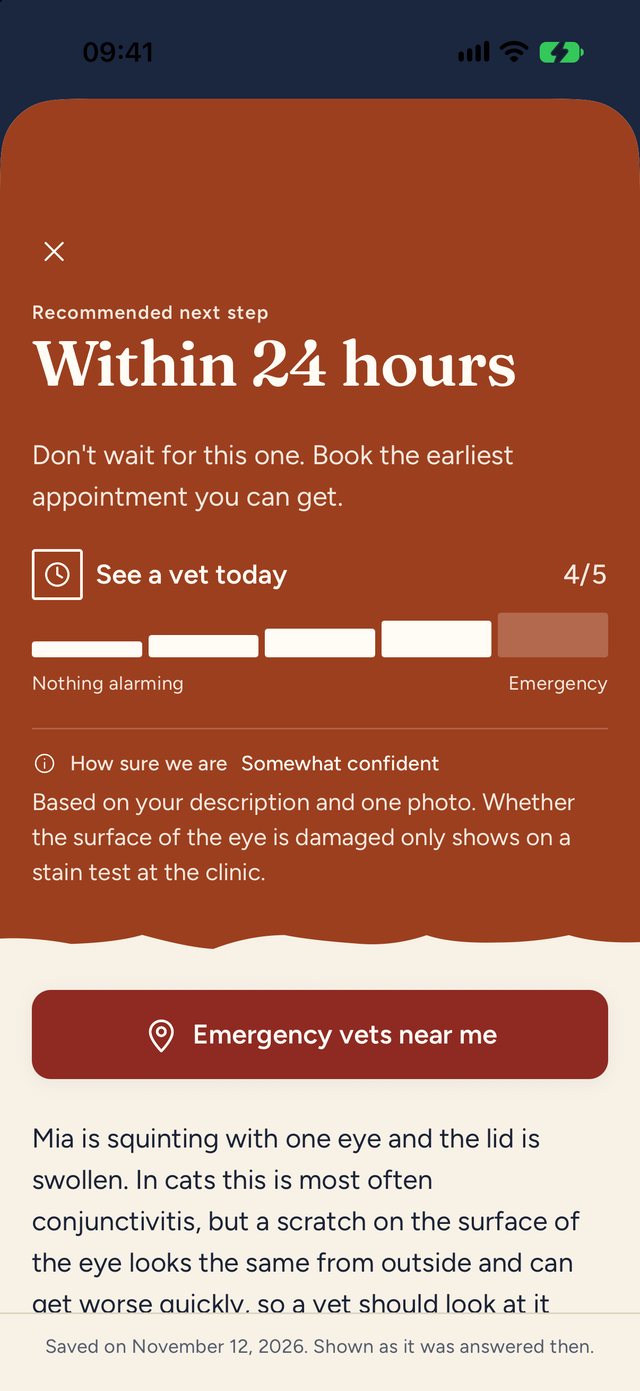
- 4See a vet todayWithin 24 hours
- 5EmergencyGo now

Free: 3 new symptom checks a month, follow-ups on an open problem, and every emergency. Premium removes the monthly limit and adds photos.
What does the symptom check actually do?
It turns "is this serious?" into a clear next step. You choose from a list of common signs (vomiting, lethargy, limping, loss of appetite, coughing, trouble breathing, a seizure and others), add a short description of when it started and how it has changed, and Pativo returns an urgency level, possible explanations, what you can do now and questions worth asking your vet.
The model also sees what the app already knows about your pet: species, sex, breed, age, weight and recent summaries such as the daily log and learned normal. A drop from your own pet's normal counts for more than a number on its own.
What are the five urgency levels?
Every result lands on one of five steps. Each step comes with a plain action, so you know what to do rather than just how worried to be.
| Level | What it means | Next step |
|---|---|---|
| Nothing alarming | Nothing suggests urgency right now | Watch at home |
| Worth watching | Track it daily; book a visit if it worsens or doesn't settle | Monitor for a few days |
| See a vet soon | Warrants a professional look, but not an emergency | Within 48 hours |
| See a vet today | Don't wait; book the earliest appointment you can | Within 24 hours |
| Emergency | Head to the nearest emergency clinic, calling ahead if you can | Go now |
A calm result is not permission to skip the vet. If you are worried, the answer is still to see one.
What is the emergency safety floor?
The emergency safety floor is a set of fixed rules that run on the server after the AI model has answered. They read the symptoms you picked and the words you wrote, and if a known red flag is present they raise the urgency. They can never lower it. When a rule changes the answer, the result says so under "Why this answer is firmer".
The rules cover the cases where under-reacting costs a life:
- Trouble breathing, collapse, pale, white, blue or grey gums, or bleeding that won't stop: Emergency.
- A seizure: See a vet today; one lasting over five minutes or repeating back to back: Emergency.
- Straining without passing urine: Emergency for a male cat, See a vet today for any other animal.
- A dog with a swollen belly and unproductive retching (possible bloat): Emergency.
- Lily mentioned for a cat, or xylitol, antifreeze, rat poison or slug pellets: Emergency.
- Other toxins reported as eaten, such as chocolate, grapes, onion or human painkillers: See a vet today.
- A rabbit or guinea pig that has stopped eating (gut stasis risk): See a vet today.
- A cat that has stopped eating: at least See a vet soon.
- A puppy under six months with both vomiting and diarrhoea: See a vet today.
These are deliberately blunt. A false alarm is acceptable here; a missed emergency is not. You can read the signs themselves in the emergency signs guide.
What is in the "Until you see the vet" plan?
For any result above Nothing alarming, the answer includes a short plan for the hours before the appointment, so "see a vet" is never the whole answer.
- How soon: the timeframe, matched to the urgency level.
- Do this now: two to five concrete steps at home, or on the way for an emergency.
- Don't do this: things that make it worse, such as giving human painkillers.
- What to tell the vet: a summary of what you reported, ready to read out on the phone or show on screen. Missing details are marked "not stated" rather than guessed.
The plan also opens your maps app to search for vets or 24-hour clinics nearby; your location stays on your phone. If you keep records, the vet report adds the last months of history on one page.
What does "Can this wait?" tell me?
It answers the question most apps skip: what waiting actually costs, and what to do if going today is not possible. It appears for every result above Nothing alarming and is written from fixed guidance, not by the model.
It covers four things. What gets worse if you wait, with firmer wording for a very young or older animal. How the cost of going now compares with going later. The signs that mean you should go now instead, such as struggling to breathe or bleeding that won't stop with pressure. And practical routes if today isn't affordable: asking for a written estimate, staging tests over weeks, payment plans, charity clinics, teaching hospitals and a phone call to your practice first. It never quotes a price, because prices vary by country and clinic.
Is it accurate?
It is a second opinion, not an examination. Pativo has published no accuracy figure and does not claim one. The model reports how sure it is (reasonably, somewhat or not confident) and says when it cannot tell enough from what you shared. It is told never to invent precision, never to invent your pet's history, and never to imply that an unfamiliar substance is safe.
What it cannot do: feel an abdomen, listen to a chest, take a temperature or run a blood test. A vet examining your pet will always know more. That is why the safety floor exists and why every result points toward a vet when in doubt.
How is this different from searching online?
A search returns pages written about other animals. Pativo reads your pet's species, age, weight and recent records, gives one verdict on a fixed scale with a timeframe, and runs the same safety rules every time. It also keeps the check, so a follow-up on the same problem is compared with what you said before.
Is it free, and what happens to my data?
The free plan includes 3 new symptom checks a month. Checking again on an open problem (up to eight follow-ups within 72 hours of the first check) does not use another, and an emergency is never limited. Premium removes the monthly limit (a fair-use ceiling only stops automated use) and adds photos to any check; photos are free in an emergency. See pricing.
Before the first check, a consent screen lists exactly what leaves your phone: the symptoms, notes and photos you add, and your pet's species, sex, breed, age, weight and recent summaries. Your name, email and location are not sent. You can withdraw consent at any time; records, reminders, the emergency guide and the poison check keep working on the device. More in the privacy policy.
Questions owners ask
Can Pativo diagnose my pet?
No. It offers possible explanations with a likelihood band and the reasoning behind each, and tells you how soon a vet should see your pet. Only a vet examining your pet can diagnose.
Which AI model reads my pet's symptoms?
The model is provided by OpenAI, and the consent screen names it before anything is sent. Your name, email and location are not sent, and your data is not used to train anyone's model.
What happens when I run out of free checks?
Follow-ups on a problem you already checked stay free, and so does the emergency guide. A check that the safety rules mark as an emergency is never refused because the monthly allowance is used up.
Does it work without an internet connection?
The symptom check needs a connection because the model runs on a server. The emergency guide and the poison lookup work offline on your phone.
Will it ever tell me to give my pet a medicine?
No. The model is instructed never to recommend a medication or dose, and the server removes any line in the home-care and plan lists that names a drug or a dose before you see it.