How does Pativo learn what is normal for my pet?
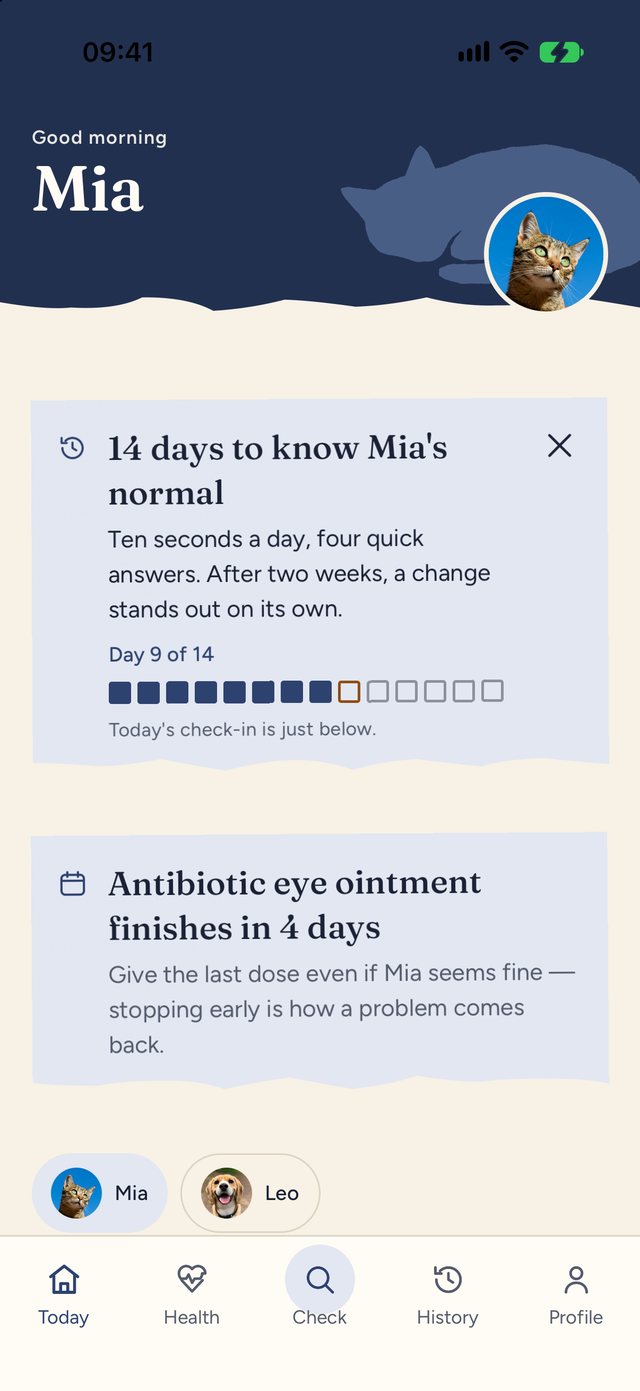
Once a day you answer four questions: appetite, energy, drinking and toilet, each on a five-point scale from Much less to Much more. It takes about ten seconds. After at least 7 days of check-ins within a 14-day window, Pativo knows your pet's usual range and tells you when a measure stays outside it for two days or more.

The daily check-in, the learned normal, drift alerts and the morning forecast are free on every plan, for every pet.
What do I answer each day?
Four questions, one tap each. How is your pet's appetite, energy, drinking and toilet today, compared with usual? Each answer sits on the same five-point scale: Much less, A little less, Normal, A little more, Much more. You can set a daily reminder at a time that suits you.
The questions are deliberately simple. An owner can answer them honestly in ten seconds, and that matters more than precision: a log that is kept every day beats a detailed one that is abandoned in a week.
How long does it take to learn my pet's normal?
Pativo needs at least 7 days of check-ins within the last 14 days. Until then the home screen counts down ("4 more days and we'll know their normal"). Several check-ins on the same day count as one day, so a busy morning cannot skew the picture.
The learned normal is the average for each of the four measures over that window, with the usual day-to-day spread around it. It keeps updating as you log, so it follows your pet as it ages or the seasons change.
When does Pativo flag a change?
A change is flagged when a measure sits well outside your pet's own usual range (about one and a half times its normal day-to-day spread) for at least two days in a row, all in the same direction. A single odd day is treated as noise, because every animal has one.
When that happens you see it on the home screen ("Appetite has been outside the usual range for 3 days") and, if notifications are on, you get one message for that run of days, not one every day. A gap in logging ends the run; a new run after a normal day is announced again.
| What you log | What Pativo does |
|---|---|
| Fewer than 7 days in the last 14 | Records, and counts down to a learned normal |
| One unusual day | Nothing; one day is noise |
| Two or more unusual days in a row, same direction | Flags the measure on the home screen and notifies you once |
| A slow drift that stays inside the usual range | Mentions the trend on the morning card, with "nothing to act on yet" |
What is the morning forecast?
The forecast is one sentence on the home screen each day about what is coming, not a summary of what was logged. It picks the single most useful thing, in this order:
- A change that has lasted, projected forward ("if it's still low tomorrow that's 4 days, which is the point it stops being a bad patch").
- A vaccination due within the next 10 days.
- A medication course ending within the next 10 days, with a reminder to give the last dose.
- How many more days until the normal is learned.
- A gentle trend in one measure, or that your pet is holding steady.
It does not predict illness. It only projects trends already visible in your own records and names what is already scheduled. Anything more would be precision the data cannot carry.
How is this different from a symptom checker?
A symptom checker answers one question at one moment. A daily log knows what normal looks like for this particular animal, which is what makes a change noticeable before it becomes a crisis. A cat that usually drinks little and has drunk a little more for four days is a different story from a cat that always drinks a lot.
The two work together. When you run a symptom check, the averages from your log go with it, so a drop from your pet's own normal weighs more than a number on its own. And the vet report shows the vet how many check-ins you made, the averages and any recent changes, with dates.
What does it not do?
It does not diagnose and it does not replace looking at your pet. The scale is your judgement, so it is only as good as your answers. A change from normal is a reason to look closer or ask a vet, not a verdict. It also cannot catch something sudden: if your pet has trouble breathing, collapses or has a seizure, do not wait for a trend. Go to the emergency signs.
For things that happen between check-ins, such as a vomit at 3 a.m. or a limp after a walk, use the one-tap quick log.
Is it free, and where is my data kept?
The daily check-in, the learned normal, the drift alerts and the forecast are free on every plan, for every pet, with no limit. They are part of the app's promise that what keeps an animal safe is never behind the paywall. Premium adds photo checks against a photo from a healthy day and symptom checks without a monthly limit; see pricing.
Check-ins are stored encrypted on your phone and synced to your own account so they survive a new phone. The calculations run on the device. You can export every check-in as PDF, CSV or JSON at any time, free. More in the privacy policy.
Questions owners ask
What if I miss a day?
Nothing breaks. The learned normal is built from the days you did log in the last 14, and it needs at least 7 of them. A missed day only pauses a run of unusual days, it doesn't count against you.
Does it work for fish?
Yes. For a fish the drinking and toilet questions become water quality and waste in the tank, so the same four-question habit still applies.
Will I get a notification every time something is a little off?
No. One odd day is ignored. A change has to hold for at least two days in a row, and each run is announced once, however long it lasts. You can turn these notifications off.
Is the learned normal sent to an AI?
Only if you run a symptom check and have given consent; the averages then help the model judge your pet against its own normal. The check-in and the drift alerts themselves are worked out on your phone.